Showing posts with label Friday Five. Show all posts
Showing posts with label Friday Five. Show all posts
Monday, August 10, 2015
Five Fact Friday: Plant Hunters - Ernest Wilson

2. His first plant hunting expedition was in 1899, employed by Jame Veitch & Son. He was given the special mission of finding the handkerchief tree. Leaving Liverpool to travel to America on his was to China, he took a detour to the Arnold Arboretum, meeting Charles Sargent - a key player in Ernest's later life. After a false start, Wilson found the Handkerchief tree on 19 May 1900. He gathered a large quantity of the seed and found hundreds of other interesting plants in the area.
3. After marrying Helen Ganderton in the June of 1902, Wilson was off to China again on January 23 1903 for a two year trip. This time his object was the poppy Meconopsis integrifolia, which he found on the 15 July 1903 as a dazzling sheet fluttering in the mountain breeze. He returned home with the seed of 510 species and 2400 herbarium specimens.
4. His last adventures were with the Arnold Arboretum, first in China and finally in Japan - where Helen became the first wife of a British plant hunter to go on a plant hunting expedition. These expeditions were as successful as all the rest and in total Wilson is credited with the introduction of over 1000 species. Sadly Ernest and Helen were killed in a road accident in October 1930.
5. Some of the over 1000 species he discovered include: Viburnum davidii, Lilium regale, and Magnolia sinensis.
Resources:
Musgrave, T. (1998) The Plant Hunters, London, The Orion Publishing Group

Five Fact Friday: Plant Hunters - Robert Fortune
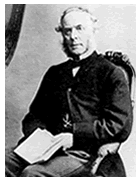
2. After an apprenticeship at nearby garden, in 1842 he applied for the post of Superintendent of the Hothouse Department at the Horticultural Society's Chiswick garden. After just a few months working there, he was chosen to spend a year gathering information about Chinese gardening and collecting new seeds and plants. He was told that 'the value of plants diminishes as the heat required to cultivate them is increased', but orchids, aquatics and plants with 'very handsome flowers' were exceptions to this rule.
3. Fortune left Britain aboard the Emu, bound for Hong Kong, on the 26 February 1843. He took plants with him for delivery to the colony in Wardian cases. He had some adventure in China, including what seems to be an epic fight with a crowd that liberated him of his letters and other valuables.
4. During his time in China, he found that strangers were distrusted and disliked. They would deny that nurseries existed or claim that they were very far away. Nevertheless he purchased and found many lovely plants. He had many trips to China before retiring back in Britain in 1862.
5. Fortune is credited with discovering 120 new species, including: Weigela florida, Mahonia japonica, and Rhododendron fortunei.
Resources:
Musgrave, T. (1998) The Plant Hunters, London, The Orion Publishing Group
Friday Five: Making the most of Cut Flowers

Read more »
Five Fact Friday: Seed Dormancy
- Some seeds will only germinate after they have had a period of drying, while others need a really good soaking.
- Some seeds will germinate when fresh, which is common in the tropics. Others cannot do so because they have a thick seed cover that is impermeable to oxygen and water - these seeds need their coats wearing down and weakening over time.
- Some seeds will only germinate after a cold snap where the conditions are around 5 degrees centigrade. Others require a warm snap to get them on their way. This is known as thermodormancy.
- Known as photodormancy, some seeds require light in order to germinate, while in other seeds light will actually inhibit germination
- Some really difficult to germinate seeds require multiple dormancies, whereby they need the right conditions to present themselves twice. For instance the first dormancy may break open an impermeable seed coat, but the seed it still dormant until a cold snap awakens it.
References:
RHS The Garden, February 2013. Lancaster, N
http://en.wikipedia.org/wiki/Seed#Seed_dormancy
Friday Five: Looking after your computer
This may seem a bit off topic for a nature blog! But if you're reading this, the likelihood is that your one of the 92% (according to Blogger stats) of my readers that are reading this post on a PC or laptop.
Recently I've noticed a lot of people in the Facebook groups I'm a part of having problems with their computer, but not knowing that there are some very easy to use software tools that can help them out.
In a past life I used to be an ICT Technician registered with UK Engineering Council (ICTTech) and over the years I've come across some tools that are not only easy to use, but are both reliable and powerful.
These applications are free to download and use - there are versions that you can pay for if you want additional features, like real-time protection rather than manual running. And of course, there are other applications similar to the ones I've chosen - so make sure you choose one your happy with!In no particular order are 5 software applications that you can use to pro-actively look after your computer.
Read more »
Read more »
Recently I've noticed a lot of people in the Facebook groups I'm a part of having problems with their computer, but not knowing that there are some very easy to use software tools that can help them out.
In a past life I used to be an ICT Technician registered with UK Engineering Council (ICTTech) and over the years I've come across some tools that are not only easy to use, but are both reliable and powerful.
These applications are free to download and use - there are versions that you can pay for if you want additional features, like real-time protection rather than manual running. And of course, there are other applications similar to the ones I've chosen - so make sure you choose one your happy with!In no particular order are 5 software applications that you can use to pro-actively look after your computer.
Read more »
Five Fact Friday: Depression

I've embedded a really helpful video, from a book of the same name, at the bottom of the post - please take the time to watch it, even if you've never encountered depression (probably especially if you've never encountered depression).
While we don't need people's attention or pity, it can be so important to have the people around us understand what's going on. It can help us feel supported during the long road to recovery or for some remission.
While these facts are well known, I've added my own personal thoughts to some of them. Please feel free to leave comments :)
- Everyone can feel down at times, but this will normally pass within a few days. If it does, it's unlikely to be depression. While depression is common; it's a serious condition that can deeply impact the life of the sufferer as well as friends and family.
- More than 350 million people of all ages suffer from depression globally. So while it might not feel like it right now: you are not alone. Unfortunately, from my experience, we isolate ourselves and make a room in our house our haven.
- Depression can be situational and/or bio-chemical. It can be hard to know which it is; therefore ensure that you get help. There are effective treatments available such as counselling and medication. Unfortunately, again from my own experience, there is no immediate fix.
- Looking after plants and/or animals can really help give purpose when we feel there is none. Plants are a bit easier to start with, especially when it's a struggle to look after ourselves. I really got interested in it and now really enjoy looking after my orchids and learning more about plants in general!
- Being in nature or even just a picture of a nature setting has been shown to help. There are even many nature sound videos on Youtube - such as rain, whales, and rainforest videos. I can also help to get out and around nature, even if it's just the back garden, on a regular basis.
Five Fact Friday: Fungi


- There are believed to be between 700,000 and 5.1 million different species of fungi on Earth. If we go with the upper limit, that means we currently only know 5% of them.
- Beneath every mushroom, or fruiting body of fungus, is a network of thread-like hyphae. They create network of threads called mycelium that provide the nutrients to keep the organism alive. These threads are so tiny that in just 16 cubic cm of soil up to 13 kilometres of mycelium can be found.
- It is believed that fungi were the first organism to leave the seas and colonise the land. It is thought that they ventured on to land in the form of lichens around 1.3 billion years ago.
- The largest known specimen of fungus, Armillaria solidipes, is also the largest known organism in the world. It was found inn Oregon by Catherine Parks and extended over 900 hectares, which is around the same size as 1260 football pitches. Estimates of its weight go from 7000 tonnes to 35,000 tonnes and it may have been growing continuously from between 2400 years and 7200 years.
- The largest collection of fungi species is at the Royal Botanic Gardens at Kew. They have over 1.25 million individual specimens in their fungarium; including Alexander Fleming's original culture of penicillin and species first discovered by Charles Darwin.


Bibliography
Benson, W. (2012) Kingdom of Plants, London, Collins.
Friday Five: Earthworms and the study of
-1-
As it seems with most things, Darwin was the first to take the time to scientifically study earthworms. His final book, The Formation of Vegetable Mould, Through the Action of Worms With Observations on Their Habits, published in 1881 was a detailed study collating his experiment results from a 40 year period about the habits of the worms in his garden at Down House.Read more »
Friday Five: Plant Cells
Plant cells are amazing in function and under the microscope are beautiful to look at. There are a potentially infinite amount of interesting things to know about plant cells, but here are five features that stand out to me...
Five Fact Friday: Plants and Sight
- Like us, plants can 'see' meaning that they can detect electromagnetic waves and respond to them. This is very important as light equals energy to a plant - so the response to light stimulus can be when to grow or how fast to grow.
- Charles Darwin, and his son Francis, performed many experiments on plants during their careers. One particular experiment found that light hitting the tips of plant stems make the plant respond by bending towards the light: Phototropism.
- Plants also respond to the changing day lengths through the year. Known as Photoperiodism, the plant can detect the continuous length of darkness each night and reacts. This reaction to darkness is used on many plants, for instance the humble chrysanthemum. By switching on a red light just for a few seconds each night throughout the autumn and winter (the usual time for flowering), the chrysanthemum is prevented from flowering. Then two weeks before Mother's Day the darkness is not interrupted by switching on the light - this length on continuous darkness makes the plant respond by flowering - just in time to be shipped to supermarkets!
- Plants are also regulated by the Circadian clock, just as we are. This developed well before there was a split that developed into the Plant Kingdom and the Animal Kingdom. It would seem that these clocks may have developed to prevent damage from high UV radiation. Seen in humans as sun burn.
- Blue light is used by the plant for phototropism and the Circadian clock. Red light is used by the plant to know when to flower. Far red light, the red seen for a short period as the sun goes down is used by the plant to shut down for the night. And genetics is finding more and more photoreceptors showing the complexities of plants.
References
Chamovitz, D. (2012) What a Plant Knows, Oxford, Oneworld Book.
Friday Five: Efficient cooking
I'm not up on the science behind a lot of these tips, some of them may even just be the placebo effect working its magic on me! While they may not save you a lot of money or energy, every little helps: so give them a try. Let me know what you think of these tips and any tips you have for making your cooking efficient.
Read more »
Read more »
Read more »
Five Fact Friday: Plants and Touch
- Some plants, such as the vines of a burr cucumber are far more sensitive - up to 10 times as sensitive. In fact four, e will see why this can be so important for plants.
- Plants, such as the venus flytrap, use touch to know when to close their traps. To trigger the trap takes two hairs to be touched within 20 seconds.
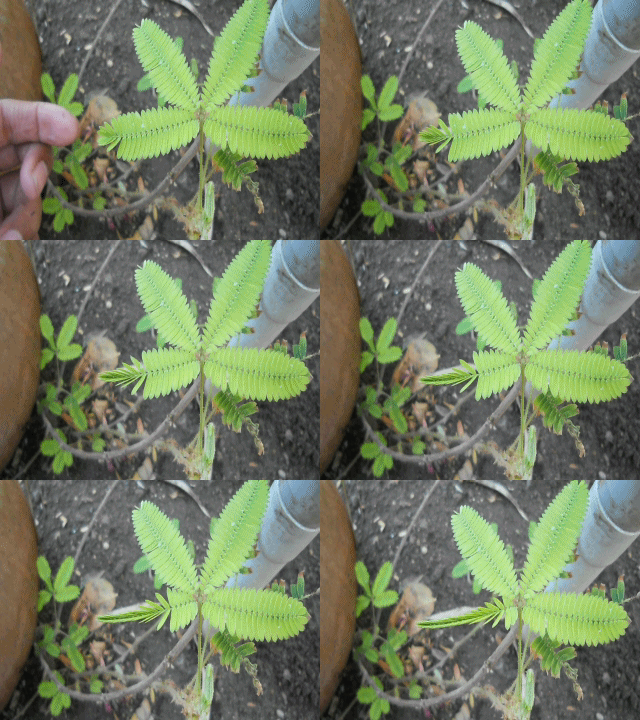
- Plants such as the sensitive plant (Mimosa pudica) react to touch by closing themselves up. Some explanations for this include the plant attempting to remove insects from its leaves, or that herbivores may not want to eat a 'moving' plant and will move on to a plant that remains still while being eaten.
- Other plants die when they've been touched. This can be beneficial to the plant as it will prefer to grow away from anything that will hinder its growth. Stresses such as wind, different types of precipitation and animal contact can change how a plant grows. An experiment on the Arabidopsis thaliana showed that just stroking the leaves just a few times each day will render the plant squatter and delay flowering than one that was left alone.
- As with us animals, plants utilise electrical charges to register touch. The movement of electrical flow within the plant can warn the rest of the plant about any current danger. An example of this was an experiment with a tomato plant by Dianna Bowles. She iced the petiole to block any chemical flow from the leaf to the stem. This doesn't stop the electrical flow, which was used to warn the rest of the plant about the danger it was under (in this case hot metal on the leaf).

Chamovitz, D. (2012) What a Plant Knows, Oxford, Oneworld Book.
http://en.wikipedia.org/wiki/File:Mimosa_Pudica.gif
Five Fact Friday: Plant Hunters - The Lobb Brothers
 |
| Phalaenopsis lobbii Named for Thomas Lobb, who in 1845 found the first of the genus growing in the Himalayas. |
1. William Lobb was born in 1809 and was followed two years later by his brother Thomas. They grew up in Egloshayle in the North of Cornwall.
2. Thomas joined the Veitch nursery around 1830, but it was William who was the nursery's first plant hunter - recommended by Thomas - and travelled to South America on 7 November 1840. Thomas was inspired by his brother's journeys and was send by Veitch to the East Indies in 1843.
3. By 1843, Veitch & Sons were selling seedlings of the Monkey Puzzle tree at 100 for £10, after William had sent back a package of 3000 seeds. Thomas and William finally saw each other again between Thomas arriving home in 1847 to arrange his collections and setting off again on Christmas Day 1848.
4. After many years of successful plant hunting, William eventually remained in California. He died in 1864 and was buried in San Francisco. Thomas retired back in Cornwall and his last contact with Veitch was in 1869. He died peacefully in 1894.
5. Both brothers discovered many wonderful plants new to Britain. William found plants such as: Ceanothus x veitchianus and Sequoiadendron giganteum. Thomas found plants such as Phalaenopsis amabilis, Nepenthes sanguinea, and Vanda caerulea.
Resources:
Musgrave, T. (1998) The Plant Hunters, London, The Orion Publishing Group
Five Fact Friday: Psychoactive Plants and Fungi
Last year I watched a few programmes about tribal life, including those of Bruce Parry - who is always up for joining in the ceremonial aspects of tribal life. These tend to include ingestion of some type of plant that has psychoactive properties. These five facts look at the reasons and early use of these plants.
Benson, W. (2012) Kingdom of Plants, London, Collins.
http://en.wikipedia.org/wiki/Religious_and_spiritual_use_of_cannabis
http://en.wikipedia.org/wiki/Bhang
http://en.wikipedia.org/wiki/Acacia#Uses_in_folk_medicine
http://www.clovegarden.com/ingred/bp_acaciaz.html
http://en.wikipedia.org/wiki/Psilocybin_mushroom#Early
Read more »
- Sometimes termed 'Plants of the Gods' many plants have been used by people for their psychoactive purposes for many thousands of years, primarily for ceremonial, religious or spiritual purposes.
- Some of the earliest evidence of people using plants for hallucinogenic purposes is that of the Peyote tribes using Lophophora williamsii around 5500 years ago. Lophophora williamsii is a spineless and rather small cactus that grows in the regions around Texas.
- Thought to have been written between 2000 and 1400BC, the Indian writings Atharva Veda mention cannabis as one of its 'Five sacred plants'. In religious festivals, the leaves and flowers of the female plant are infused into a drink called Bhang. But not only is this used for sacred purposes, it is also used for pain relief from battle wounds.
- Some species of Acacia tree have psychoactive uses with the leaves, stems and roots brewed together with other ingredients for healing, religious or ceremonial purposes. In India the fruits can be used to make an alcoholic beverage that is apparently enjoyed by both people and elephants.
- Psilocybin mushrooms, mainly of the genus Psilocybe are commonly known as 'Magic Mushrooms' because of their psychoactive properties. The natives of Mesoamerica have used hallucinogenic species of Psilocybe from pre-Columbian times right up to today for the purposes of religion, divination, and healing.
Benson, W. (2012) Kingdom of Plants, London, Collins.
http://en.wikipedia.org/wiki/Religious_and_spiritual_use_of_cannabis
http://en.wikipedia.org/wiki/Bhang
http://en.wikipedia.org/wiki/Acacia#Uses_in_folk_medicine
http://www.clovegarden.com/ingred/bp_acaciaz.html
http://en.wikipedia.org/wiki/Psilocybin_mushroom#Early
Friday Five: People of Plants: Charles Darwin
This week saw the 2014 International Darwin Day (#DarwinDay on Twitter). So to participate, I've chosen to write this week's Friday Five about the great man himself.
Read more »
Read more »
-1-
Charles Robert Darwin was born on the 12 February 1809 in Shrewsbury at Mount House, the family home. He was born to Dr Robert Darwin the son of Erasmus Darwin - who himself wrote about evolution in his book Zoonomia - and Susannah Darwin the daughter of Josiah Wedgwood who created the Wedgwood pottery firm. Together, this family is known as the Darwin-Wedgwood family, known to have at least 10 fellows of the Royal Society.Read more »
Five Fact Friday: Plants of Enormity
- The tallest - The Australian mountain ash (Eucalyptus regnans) is the largest flowering plant, regularly growing over 300 feet. The largest, measured by an official inspector of forests, was one discovered fallen and was said to have been 435 feet long.
- The oldest - The oldest bristlecone pines (Pinus longaeva) of California, are estimated to be over 4,600 years old.
- The most massive: The giant sequoias (Sequoiadendron giganteum) also of California, are the most massive plant. An example being that of the tree named 'General Sherman' at 290 feel tall, a girth of eighty feet (measured at six feet above the ground) and an estimated weight of over 6,000 tons.
- The biggest inflorescence: The plant with the biggest inflorescence is that of the titan arum (Amorphophallus titanum) with a spathe three feet across and a spadix raising to nine feet tall. See a titan arum come into flower in the video uploaded by Kew, below:
- The biggest single flower: The parasitic rafflesia (Rafflesia Arnoldi) grows the largest flowers with the record at around 42 inches, but regularly 36 inches across. It can do this, perhaps, because it doesn't need to gather its own food and instead 'steals' food from the vine it parasitises.
Attenborough, D. (1995) The Private Life of Plants, London, BBC Worldwide.
Five Fact Friday: Plant Hunters - Frank Kingdon-Ward
1. Frank Kingdon-Ward born to Professor Harry Marshall Ward in 1885.
2. His father died prematurely, lacking money to continue his education Kingdon-Ward had to find a job. He rushed his studies and got the first job that would take him abroad. This job was as a teacher at the Shanghai Public School in 1907, which he didn't really enjoy - seeing it as a means to an end.
3. He set of in September 1909 for his first official plant hunting expedition. Returning a year later to his teaching job. By 1911 he was off again, spending much of the next 45 years on hunting for plants.
4. Kingdon-Ward had a fantastic memory for locations, which enabled him to return to collect seed at the right time - for instance being the first to bring viable seed of the blue poppy. It seems that he really enjoyed these trips and would travel with his first wife, later with his second wife. Even at the age of 73 years old he was planning another trip, although he sadly fell ill, collapsing into a coma and dying on 8 April 1958.
5. He introduced plants such as Lilium mackliniae, Primula florindae, and the lovely Cotoneaster conspicuus.
Resources:
Musgrave, T. (1998) The Plant Hunters, London, The Orion Publishing Group
Read more »
2. His father died prematurely, lacking money to continue his education Kingdon-Ward had to find a job. He rushed his studies and got the first job that would take him abroad. This job was as a teacher at the Shanghai Public School in 1907, which he didn't really enjoy - seeing it as a means to an end.
3. He set of in September 1909 for his first official plant hunting expedition. Returning a year later to his teaching job. By 1911 he was off again, spending much of the next 45 years on hunting for plants.
4. Kingdon-Ward had a fantastic memory for locations, which enabled him to return to collect seed at the right time - for instance being the first to bring viable seed of the blue poppy. It seems that he really enjoyed these trips and would travel with his first wife, later with his second wife. Even at the age of 73 years old he was planning another trip, although he sadly fell ill, collapsing into a coma and dying on 8 April 1958.
5. He introduced plants such as Lilium mackliniae, Primula florindae, and the lovely Cotoneaster conspicuus.
Resources:
Musgrave, T. (1998) The Plant Hunters, London, The Orion Publishing Group
Friday Five: Orchids

-1-
Orchidaceae has around 25,000 species organised into 850 genera along with over 155,000 hybrids - a number which grows by around 300 hybrid varieties each month.
-2-
The orchid appears in texts such as Dioscorides De Materia Medica (written between 50 and 70 AD), where it was thought that if the orchids greater root was eaten by men it would give them male children, whereas if women ate the lesser root, they would conceive girls - I have no idea what they thought would happen if a child was conceived when both parties had partaken. -3-
The Dutch were the first to cultivate a tropical orchid in Europe. The orchid was listed as a Epidendrum and was introduced to Holland from Curacao and grown in the garden of Casper Fagel. This orchid became the first tropical orchid to appear in a woodcut, when it was illustrated in Paul Hermann's Paradisus Batavus (1698)-4-
In 1887 a massive orchid bouquet measuring 4' tall and 5' in diameter and said to have 50,000 orchid flowers was presented to Queen Victoria to celebrate her Golden Jubiliee. It was displayed at Buckingam Palace and was made up of Cattleya mossiae, Odontoglossum, Oncidium and Vanda, with VRI (Victoria Regina et Imperatrix) spelled out with the scarlet flowers of Epidendrum vitellinum.-5-
Importantly, due to over harvesting of orchids, they have the protection of CITES, an organisation that monitors and controls the international trade of threatened plant and animal species - including herbarium specimens. This includes all European species along with Cypripedium calceolus, all Paphiopedilum, and others.-Bonus-
Orchid flasking is where the orchids have been grown on agar instead of with a fungal partner. Sterilisation is important to prevent the growth of fungi or bacteria, which can destroy whole batches of plants. This video shows part of the process.Resources:
Jennifer Potter, 2013. Seven Flowers: and How They Shaped Our World. Edition. Atlantic Books.
Sunday, August 9, 2015
Five Fact Friday: Antarctic Expeditions
- 27 January 1820 is the date of the first sighting of mainland Antarctica. It was made by Captain Baron thaddeus Von Bellingshausen of the Imperial Russian Navy.
- On 25 January 1895, Carsten Borchgrevink became the first person to make a confirmed landing on the Antarctic continent.
- Arriving in 1899, Borchgrevink's party were the first to build on Antarctica. Their prefabricated huts were built at Cape Adare.
- Roald Amundsen was first to reach the South Pole, reaching it on 14 December 1911. Captain Robert Scott's British team arrived on 17 January 1912.
- The first filming of the Antarctic was in 1912 by Herbert Ponting with Captain Scott. Life in the Freezer presented the continent to us in 1993 and The Frozen Planet was broadcast in 2012 and provided awe inspiring stories of the life that exists in the polar regions with the most fantastic technology available.
Fothergill, A. (1993) Life in the Freezer, London, BBC Books.
Five Fact Friday: Geocaching
To celebrate the recent achievement of 2 million active Geogaches on Geocaching.com, here are 5 fab facts about Geocaching:
If you want to give it a go just create a free account at either of the sites below. You will also need either a dedicated GPS device, or if you have a smart phone then you'll need to download an app for that!
http://www.geocaching.com/
http://www.opencaching.com/en/
Read more »
- Coined backed in 2000, Geocaching is the term that describes those of us that hunt treasure (caches) using a GPS Device.
- Dave Ulmer was the first person to hide a geocache. He hid it to test the accuracy of the improved GPS signal available to civilians.
- Geocaching.com is one of the main providers of geocaching adventures. They currently have 1,999,615 active (that's available to find) geocaches in over 180 countries.
- There are many types of cache available, and therefore adventure to be had, including traditional caches, multi-caches, and my favorite: Earth caches - for which you can be awarded.
- You can even use travel bugs to increase the fun! Travel bugs are game pieces that travel from cache to cache with their own little mission. Sometimes that mission is to reach a certain place, sometimes it's to reach certain caches - eg. caches at motorway service stations. You can even view their progress on Google Earth and see the, sometimes, many thousands of miles they have travelled since first being placed.
If you want to give it a go just create a free account at either of the sites below. You will also need either a dedicated GPS device, or if you have a smart phone then you'll need to download an app for that!
http://www.opencaching.com/en/
Subscribe to:
Posts (Atom)